

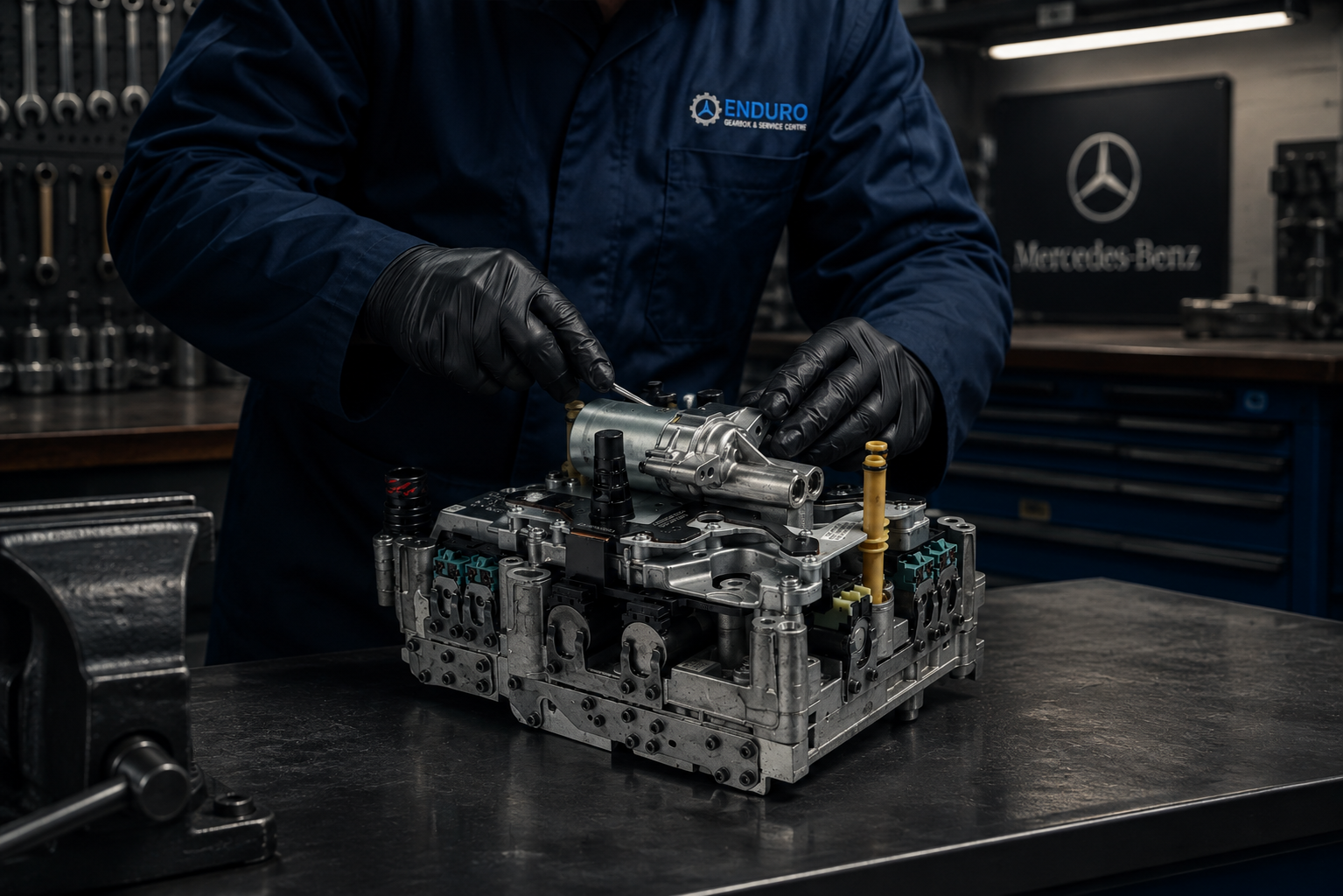
Mercedes-Benz Mechatronic Units Explained: What They Do and Why They Fail
What Is a Mercedes-Benz Mechatronic Unit?
If you’ve been told your Mercedes-Benz has a mechatronic unit fault, you’re not alone. It’s one of the most common diagnoses for modern Mercedes-Benz automatic transmissions, yet many owners have no idea what a mechatronic unit actually does.
The good news is that a mechatronic problem doesn’t always mean you need a complete gearbox replacement. In many cases, the issue can be repaired if it’s diagnosed early by a transmission specialist.
At Enduro Gearbox & Service Centre, we specialise in diagnosing, repairing, and replacing Mercedes-Benz mechatronic units, helping customers avoid unnecessary gearbox replacements and costly repairs.
What Does a Mercedes-Benz Mechatronic Unit Do?
Think of the mechatronic unit as the “brain and nervous system” of your automatic transmission.
It combines sophisticated electronics with hydraulic controls to ensure your gearbox changes gears smoothly and efficiently.
The mechatronic unit is responsible for:
- Controlling gear changes
- Managing hydraulic pressure
- Operating transmission solenoids
- Monitoring transmission sensors
- Communicating with the engine control unit (ECU)
- Optimising shift quality and fuel efficiency
Without a properly functioning mechatronic unit, your Mercedes-Benz transmission cannot operate as designed.
How Does a Mechatronic Unit Work?
Modern Mercedes-Benz automatic transmissions rely on constant communication between electronic sensors and hydraulic components.
The process works like this:
- Sensors monitor vehicle speed, engine load, throttle position, and transmission temperature.
- The Transmission Control Module (TCM), often integrated into the mechatronic unit, processes this information in real time.
- Hydraulic solenoids receive instructions from the control module.
- The solenoids direct transmission fluid through the valve body.
- Hydraulic pressure engages the correct clutch packs and gear sets.
- The transmission shifts into the appropriate gear smoothly and efficiently.
This entire process happens in fractions of a second, hundreds of times during every journey.
Why Do Mercedes-Benz Mechatronic Units Fail?
Although Mercedes-Benz transmissions are engineered for durability, mechatronic units are exposed to heat, vibration, electrical stress, and constant hydraulic pressure.
Over time, these conditions can lead to component failure.
Common causes include:
- Electronic circuit failure
- Faulty transmission solenoids
- Hydraulic valve wear
- Internal contamination
- Dirty or degraded transmission fluid
- Water or moisture damage
- High transmission temperatures
- General wear from high mileage
Regular transmission servicing can help reduce some of these risks by keeping the hydraulic system clean and properly lubricated.
Common Symptoms of a Failing Mechatronic Unit
A faulty mechatronic unit can produce a wide range of symptoms.
Some of the most common include:
- Harsh or jerky gear changes
- Delayed gear engagement
- Gear slipping
- Vehicle stuck in one gear
- Limp mode activation
- Transmission warning lights
- Failure to shift into Drive or Reverse
- Erratic gear selection
- Reduced acceleration
- Check Engine Light
Because many of these symptoms can also indicate other transmission problems, professional diagnostics are essential before replacing any components.
Can You Continue Driving with a Faulty Mechatronic Unit?
It is generally not recommended.
Driving with a faulty mechatronic unit can:
- Increase internal gearbox wear
- Cause clutch pack damage
- Lead to overheating
- Create additional hydraulic problems
- Result in more expensive repairs later
If your vehicle enters limp mode or displays gearbox warning messages, have it inspected as soon as possible.
Repair or Replace? Which Option Is Better?
One of the biggest misconceptions is that every faulty mechatronic unit must be replaced.
In reality, the correct solution depends on the nature of the fault.
Repair May Be Suitable If:
- Individual electronic components have failed
- Solenoids require replacement
- Hydraulic faults can be corrected
- Minor internal damage is present
- Software updates or recalibration resolve the issue
Repairs are often more cost-effective when the problem is identified early.
Replacement May Be Necessary If:
- The electronic control module has suffered extensive damage
- Internal hydraulic components are beyond repair
- The unit has experienced catastrophic failure
- Severe contamination has caused irreversible damage
- Multiple internal faults are present
An experienced Mercedes-Benz transmission specialist can determine the most appropriate solution after a full diagnostic assessment.
How Long Does a Mercedes-Benz Mechatronic Unit Last?
There is no fixed lifespan, as longevity depends on several factors, including:
- Driving habits
- Service history
- Transmission fluid quality
- Vehicle mileage
- Operating temperatures
- Overall transmission condition
With proper maintenance, many mechatronic units can provide reliable service for well over 200,000 kilometers. However, neglecting transmission servicing, using incorrect transmission fluid, or ignoring early warning signs can significantly reduce their lifespan.
Routine maintenance remains one of the best ways to maximise the life of both the mechatronic unit and the entire transmission.
How Professional Diagnostics Prevent Unnecessary Repairs
Accurately diagnosing a mechatronic fault requires specialised diagnostic equipment and experience.
At Enduro Gearbox & Service Centre, we use advanced Mercedes-Benz diagnostic tools to:
- Read manufacturer-specific fault codes
- Monitor live transmission data
- Test transmission solenoids
- Check hydraulic pressure
- Evaluate electronic communication
- Inspect transmission fluid condition
- Identify the root cause before recommending repairs
This ensures customers receive the correct repair—not an expensive replacement they may not need.
Why Choose Enduro Gearbox & Service Centre?
Mercedes-Benz transmissions are among the most advanced automatic gearboxes on the road today. Their repair requires specialist knowledge, precision diagnostics, and years of hands-on experience.
At Enduro Gearbox & Service Centre, we specialise in:
- Mercedes-Benz mechatronic repairs
- Valve body repairs
- Conductor plate replacements
- 7G-Tronic repairs
- 9G-Tronic repairs
- Automatic transmission servicing
- Complete gearbox rebuilds
- Advanced Mercedes-Benz diagnostics
Our experienced technicians understand these complex systems and are committed to providing honest advice and cost-effective repair solutions.
Don’t Ignore the Warning Signs
A faulty mechatronic unit doesn’t always mean a complete gearbox replacement—but delaying repairs can turn a manageable problem into a major expense.
If your Mercedes-Benz is displaying gearbox warning lights, shifting harshly, entering limp mode, or showing any unusual transmission behaviour, it’s time to have it professionally diagnosed.
Early diagnosis can often prevent more extensive repairs and help keep your Mercedes-Benz performing at its best.
Contact Enduro Gearbox & Service Centre Today
Whether you need a transmission diagnostic, mechatronic repair, or expert advice, the team at Enduro Gearbox & Service Centre is ready to help.
Book your inspection today and let our Mercedes-Benz transmission specialists get you back on the road with confidence.
Frequently Asked Questions
What is a Mercedes-Benz mechatronic unit?
A mechatronic unit is an advanced component that combines electronic controls and hydraulic systems to manage gear changes in an automatic transmission. It controls shift timing, hydraulic pressure, and communication between the transmission and engine.
What causes a Mercedes-Benz mechatronic unit to fail?
Common causes include electronic component failure, worn solenoids, contaminated transmission fluid, overheating, internal hydraulic wear, and general age-related deterioration.
Can a faulty mechatronic unit be repaired?
Yes. Many mechatronic units can be repaired if the fault is identified early. Depending on the extent of the damage, repairing individual components may be more cost-effective than replacing the entire unit.
What are the symptoms of a failing mechatronic unit?
Typical symptoms include harsh gear changes, delayed engagement, slipping gears, limp mode, warning lights, difficulty selecting gears, and poor overall transmission performance.
How long does a Mercedes-Benz mechatronic unit last?
With regular servicing and the correct transmission fluid, many mechatronic units can last well beyond 200,000 km. Proper maintenance and early diagnosis are key to maximising their lifespan.
Get in Touch with a Mercedes-Benz Specialist Today
If you are experiencing any Mercedes-Benz gearbox related problems, don’t just trust any workshop. Bring it to the specialists.
Contact Enduro Gearbox Centre for expert advice and accurate resolution of any Mercedes-Benz gearbox related problem.
✅ Visit our Website
✅ Follow us on Facebook
✅ Contact us today for a diagnostic or consultation
Unit A2, Fountains Industrial Park
22 Dan Jacobs Road, Alrode, 1451